 Casino HarbourCanada · independent guideWinshark offer
Online casino Canada instant withdrawal: whose clock are you actually watching?

Winshark · Partner offerExplore WinsharkCheck terms and local eligibility. Legal gambling age applies.
An online casino Canada instant withdrawal is never one event. It is two queues in a row: the operator approves the request, then a payment provider moves the money. "Instant" in marketing copy almost always describes the second queue, and sometimes only part of it. Funding an account is the easy half — Interac e-Transfer, debit cards and e-wallets all deposit in Canadian dollars at most cashiers open to Canadians, and the money usually shows in the balance within minutes.
Getting it back out is where the conditions live. Expect the account to be in Canadian dollars, identity verification to be completed before the first payout rather than after, and the withdrawal to be routed back to the method that funded the account wherever that is technically possible. Minimums, daily and weekly caps, and the review window during which a request can still be cancelled are all set per operator and shown in the cashier, not on a marketing page. Interac e-Transfer is the quickest Canadian rail once a payout is released, but it is the operator's release — not Interac — that usually decides the total wait.
This directory brings together 50 online casino brands searched across Canada—including platforms relevant to Ontario and Quebec players—so you can compare how they work in one place without bouncing between pages. Each brand entry covers the topics people actually look up, from sign-up and login to bonuses, promo codes, slots, live tables, sportsbook sections, and payment options, while strictly avoiding invented scores, fabricated statistics, or unverified claims.
What an online casino Canada instant withdrawal really measures
Pull apart any payout and you find the same two stages. Stage one is internal: a human or a rules engine at the operator looks at your request and either releases it or holds it. Stage two is external: a payment provider pushes funds down a rail — Interac e-Transfer, a push-to-card credit, an e-wallet transfer, an electronic funds transfer to your bank, a blockchain transaction. Each stage has its own clock, its own failure modes and its own owner.
When a site advertises instant payouts, read the claim as a statement about stage two. A rail that completes in minutes is genuinely useful, but it only starts counting when stage one lets go. This is why two players at the same casino, both using Interac, can report completely different experiences and both be telling the truth: one was already verified and withdrawing to the account she deposited from, and the other had just changed banks mid-session.
There is a third clock nobody advertises: the receiving institution's. An e-Transfer that Interac has delivered still has to be accepted and posted by your bank or credit union. With Autodeposit switched on, that is usually seconds. Without it, the money sits as a pending notification until you open the link and answer the security question, and the clock that your screenshot shows is your own.
The honest definition
A payout is as fast as the slowest of those three stages. So the only version of "instant" worth chasing is the one where you have already removed everything you control: verification done, withdrawal method already used for a deposit, bonus conditions either finished or declined, Autodeposit on at your bank, and a request made with no bonus balance tangled into it. Do that and the operator's review becomes the only variable left, which is exactly the position you want to be in.
Queue one: the operator's approval, and what holds it
Approval is a risk and compliance decision, not a payment. The cashier shows it as a status — pending, processing, in review, approved — and the words differ between brands. What matters is that in this state the money has left your playable balance but has not left the operator. Our notes on a payout that sits in pending cover what each status usually means and what to ask for.
Six things routinely stall this queue, and five of them are inside your control.
- The reverse window. Many cashiers hold a withdrawal for a set period during which you can cancel it and put the money back into play. That period is part of the payout time whether you use it or not, and the figure is in the terms rather than in the advertising. Some operators let you lock it — a flush or no-reversal setting — and switching that on is the single cheapest speed improvement available.
- Unfinished bonus conditions. A withdrawal requested while wagering is incomplete is not slow, it is usually refused, and some cashiers forfeit the bonus balance at that point. Check whether the balance you are withdrawing is cash or still bonus-linked before you request anything.
- Verification not complete. The first payout is where identity gets confirmed if it was not confirmed earlier. See the next section but one; this is the delay most worth pre-empting.
- A method the account has never used. A withdrawal to a destination with no matching deposit history is a flag everywhere, because it is what account takeover looks like. Expect extra checks.
- Amount against your own pattern. A payout much larger than anything the account has handled before gets more eyes on it. That is not an accusation, it is how anti-money-laundering obligations work in practice.
- Staffing. Finance and compliance teams do not all run 24/7. A request made late on a Friday can wait for Monday for no reason other than who is on shift, and no payment rail can fix that.
One more detail about weekends that surprises people: the operator's review may well be automated and run around the clock, while the bank rail at the other end only settles on business days. The reverse also happens. You can be approved on a Sunday and still watch an electronic funds transfer sit until Tuesday, because Interac e-Transfer runs continuously but ordinary bank settlement does not.
The cap that turns a win into a payment plan
Withdrawal limits are the part of this queue that nobody notices until it bites. Terms commonly set a maximum per transaction, per day, per week and per month, and a large win is then released in instalments against whichever cap is tightest. That is not a delay in the sense of a stalled request; it is the payout working exactly as written, just over weeks. A site that pays in minutes and caps weekly withdrawals low is slower, in the only sense that matters, than a site that takes a day and has no meaningful ceiling.
Progressive jackpot wins often sit under a separate clause again, with their own schedule and their own verification. If you are playing anything with a jackpot attached, the payout clause for jackpots is the one worth reading before you spin, not the general one. And read the caps as a set: a generous per-transaction limit means nothing if the weekly figure above it is small.
Queue two: the rails the money actually travels on
Once released, the speed is a property of the rail, and the rails available to Canadians behave very differently. Nothing here is operator-specific — these are the characteristics of the payment networks themselves.
Interac e-Transfer
The fastest domestic route for most people, and the one Canadians actually use. It moves between participating Canadian financial institutions, needs only an email address or mobile number, and does not care whether it is a weekday. Its limits are set by your own bank, not by the casino, and the receive side can hold a transfer for review. The detail is worth its own page: comparing Interac payout speeds goes through the variations brand by brand.
Push-to-card credits
A payout sent back to a Visa or Mastercard debit card as a card credit rather than a bank transfer. Typically quick when it works, but three parties have to agree: the operator's processor, the card network, and your card issuer. Issuers can and do decline credits from gambling merchants, and many prepaid and reloadable cards cannot receive a credit at all even though they happily take payments. If you funded with a prepaid card, assume the payout will go somewhere else — which also means a fresh verification step for the new destination.
E-wallets
Fast into the wallet, then as fast as the wallet's own withdrawal to your bank. People quote the first leg and forget the second. If the wallet then takes business days to reach your chequing account, the payout was not instant, it was staged.
Electronic funds transfer and cheques
Direct bank transfer is the most reliable for large amounts and the least interesting for speed: business days, settlement windows, no weekends. A cheque is the slowest route still offered anywhere and generally appears only when nothing else can receive your money. Both are fine as a destination; neither belongs in a sentence with the word instant.
Crypto rails
Network confirmation can be quick, but the figure that matters is the whole journey: operator release, network confirmations, then your exchange's own crediting and any conversion back to Canadian dollars. Holding a payout in a volatile asset is a separate risk from the payout itself, and the conversion spread is a real cost that never appears in a payout-speed table.
Fees: who takes a cut on the way out
Speed and cost are separate questions, and a fast route is not automatically a cheap one. Four places take money out of a Canadian payout, and only one of them is usually disclosed in the cashier:
- The operator. Many terms allow a fee on withdrawals beyond a set number per week or month, or below a stated minimum. The number of free payouts per period is the figure to look for, because it quietly punishes anyone who withdraws in small amounts.
- The payment provider. Processor fees are often absorbed, but not always, and they are more common on card credits and cheques than on e-Transfer.
- Currency conversion. If the account is not in Canadian dollars, you pay a spread on the way in and again on the way out, at the operator's rate rather than your bank's.
- Your own bank. Incoming e-Transfers are typically free on a standard chequing account, but incoming wires are not, and some accounts charge per transaction once a monthly allowance is used up.
None of those figures can be quoted honestly in a guide, because every one of them is set per operator, per processor and per bank account. What a guide can tell you is where to look: the withdrawal section of the terms for the first two, the account currency selector for the third, and your own account agreement for the fourth.
Interac e-Transfer, and where it stops being fast
Interac deserves the detail because it is the only rail in this list that was built for Canadians and is used by nearly every Canadian bank and credit union. It is also the rail most often blamed for delays it did not cause.
Here is the sequence. The operator's processor initiates a transfer to the email address or mobile number on your casino account. Interac notifies you. If your bank account has Autodeposit registered for that address, the money lands with no further action and you get a confirmation. If not, you follow the notification, pick your institution, sign in and answer the security question the sender set. Only then does your bank credit the account.
Each of those steps is a place where a payout stops being instant:
- The address has to match. The email or number on the casino account must be the one registered at your bank for Autodeposit, character for character. An old address, a typo, or an account registered under a different email means the automatic path is off and you are back to the security question.
- The security question has to be answerable. If the processor sets it and your support ticket is the only place the answer lives, the transfer can expire unclaimed and have to be reissued — a round trip that can cost days.
- Your bank sets the ceiling, not the casino. Send and receive limits on e-Transfer are a product of your own institution and your account type. A payout above your receive limit does not fail cleanly; it can be split, bounced back to the operator, or held.
- Credit unions and smaller institutions vary. Participation is broad but not identical, and some institutions apply their own review to incoming transfers from payment processors.
- Returned transfers go back to the sender. A transfer that is not claimed within its expiry window returns to the operator, and the second attempt starts the operator's queue again rather than resuming where it left off.
The practical move before your first payout is unglamorous: switch Autodeposit on at your bank for the exact address on your casino account, then make a small test withdrawal before you ever need a large one. You will learn more from one small payout than from any amount of reading, including this page.
Who owns the clock on each route
The table below is about ownership, not durations. Published durations belong to the operator and its processor and change without notice, so the useful question is who you would have to chase if a payout stalled.
| Route | Who releases it | Who can still delay it | The usual reason it stalls |
|---|---|---|---|
| Interac e-Transfer | Operator's finance team or rules engine | Your bank, through Autodeposit settings and receive limits | Address mismatch, unclaimed transfer, receive limit below the payout |
| Push-to-card credit (debit card) | Operator's processor and the card network | Your card issuer | Issuer declines credits from gambling merchants; prepaid card cannot receive |
| E-wallet | Operator | The wallet, on its own withdrawal to your bank | Only the first leg is fast; the wallet-to-bank leg is business days |
| Electronic funds transfer | Operator | Settlement windows at both banks | No weekend or holiday settlement |
| Crypto | Operator | The network, then your exchange | Confirmations plus exchange crediting plus conversion back to dollars |
| Cheque | Operator | Courier or post, then your bank's hold on deposited funds | Everything about it |
Read the second column again. On five of six routes the operator is the one who releases the money, which is why the fastest rail in the country cannot rescue a slow approval queue. If you want to compare brands properly, compare what they publish about approval, not about transfer: our same-day payout comparison is built around the whole transfer rather than the headline leg.
Verification: the delay you can remove before you play
Every operator that pays Canadians has to know who it is paying. In Ontario's regulated market that duty sits in the registration conditions; offshore it sits in the licence the site holds and in the correspondent-banking requirements of its payment processors. Either way, there is no version of online gambling where a stranger gets paid, and the only real question is whether the checking happens before or after you want your money.
Do it first. Most cashiers let you upload documents the day you register, before the first deposit, and a verified account turns the first withdrawal into a payment rather than an investigation. The verification walkthrough covers what gets accepted and why uploads come back rejected.
What gets asked for
- Identity. A government photo identification document, in date, with all four corners visible and nothing cropped. Provincial driver's licence or a passport are the usual choices.
- Address. Something recent in your name at your current address: a utility bill, a bank or credit-card statement, a government letter. A screenshot of online banking is often refused because it has no issue date on it.
- Payment ownership. Proof that the method is yours. For a card, usually an image showing the name and the last digits with the rest covered. For a bank account, a void cheque or a statement header. For a wallet, a screenshot of the account page showing your name.
- Source of funds, sometimes. For larger amounts, a payslip, a statement or a tax document. This is the request that surprises people most and the one with the longest turnaround, which is another argument for making your first payout a small one.
What re-triggers a check you thought was finished
Verification is not a one-time gate. Adding a new withdrawal method, changing your address or name, moving provinces, a payout well above your usual pattern, or a long dormant period can each reopen it. None of that is unreasonable; it is just worth knowing that "already verified" refers to a state of the account as it was, not a permanent exemption. If you are planning a larger cashout, volunteer the documents before you request it.
Practical details that decide whether an upload clears first time: photograph the document flat in daylight rather than scanning it through an app that compresses it to nothing, do not crop, do not cover anything that is not a card number, use the file formats the page lists, and upload through your account rather than emailing anything. Keep a copy of what you sent and the date you sent it.
Names, joint accounts and the third-party rule
The strictest rule in the whole process is also the simplest: the casino account, the payment method and the documents must all be in one name, yours. No operator that intends to stay licensed anywhere will pay a third party, and that is not a customer-service decision anyone can be talked out of. It is the line between a payout and a money transmission, and it is the one place where politely escalating a ticket achieves nothing at all.
That catches more Canadians than you would expect. A joint chequing account where the first-named holder is your spouse. A card issued to a household member. A shortened first name on the casino account against the legal name on your driver's licence. A married or changed surname updated at the bank but not at the casino, or the other way round. A middle name present on one record and absent on the other. Each is a benign difference and each can hold a withdrawal while it is reconciled.
Fix it at registration, where it costs nothing: register under the exact legal name on the identification you intend to use, and fund the account from something that carries that name alone. If a name has genuinely changed, send the supporting document — a marriage certificate or a change-of-name record — before you request the first payout rather than during it.
The same-method rule and the deposits that cannot receive
Operators return money the way it came in. This is not a policy any single casino invented — it is closed-loop payment practice, required by anti-money-laundering rules and reinforced by the card schemes, and it exists so that a gambling account cannot be used to move money between two unrelated places. For you it has one blunt consequence: the method you deposit with largely decides how you get paid, and you make that decision before you have any winnings to think about.
The complication is that some deposit methods are one-directional.
| Funded with | Can it receive a payout? | What the cashier does instead | What that costs you in time |
|---|---|---|---|
| Interac e-Transfer from your own bank | Yes, and it is the fastest domestic option | Nothing — same rail both ways | Nothing, once Autodeposit is set |
| Debit card | Often, as a card credit, if the issuer accepts it | Falls back to bank transfer or e-Transfer | A new destination means a fresh ownership check |
| Credit card | No — a payout is not a refund | Routed to a bank account or e-Transfer | Verification of a method with no deposit history |
| Prepaid card or voucher | Usually not | Bank transfer or e-Transfer in your name | The slowest case: new method, new documents |
| E-wallet | Yes, back to the same wallet | Nothing, then the wallet's own payout to your bank | The second leg, which is business days |
| Crypto | Yes, to a wallet you control | Nothing | Confirmations, exchange crediting, conversion |
Look at rows three and four. A voucher or prepaid deposit is pleasant at the cashier and expensive at the exit, because the payout has to find a destination the account has never used, and that destination needs proving. If you intend to withdraw to your bank, fund from your bank. Our banking overview lays out which methods a Canadian cashier is likely to list in each direction, and the withdrawal list is always the shorter one.
One more rule worth knowing: partial-method splitting. If you funded from three sources, some cashiers will return the money across all three, in the proportions their rules dictate rather than the ones you would choose. A payout split three ways takes as long as its slowest leg, so a tidy deposit history is a faster deposit history.
Keep the account in Canadian dollars
The currency you pick at registration is usually permanent, and it is a payout decision disguised as a preference. An account held in Canadian dollars takes your deposit at face value and pays it back the same way. An account held in US dollars or euros converts twice — once when your bank funds it and once when the payout comes home — and both conversions happen at the operator's rate, not your bank's. On a small deposit that is an annoyance. On a four-figure withdrawal it is a real amount of money, and it is invisible, because neither leg is ever labelled as a fee.
There is a speed consequence too. A conversion is another step, and another step is another place for a payout to be held for review. If the cashier offers Canadian dollars, take it even when a bonus looks marginally better on the other currency, and check the balance is denominated in dollars before the first deposit rather than after.
A payout timeline, worked through as an example
The two sequences below are illustrations. The amounts are invented, the stages are real, and no figure here comes from a named operator. The point is to show where time actually goes.
Example A: the prepared account
- You registered, uploaded identification and an address document the same evening, and the account showed as verified before your first deposit.
- You funded with Interac e-Transfer from your own chequing account, in Canadian dollars.
- You declined the welcome offer, so the balance is all cash with no wagering attached.
- You request a payout to the same e-Transfer address, which has Autodeposit registered at your bank.
- The cashier shows the request as processing. Because you turned the reversal option off, there is no cancellation window to wait out.
- The operator releases it. Interac delivers to your registered address; your bank posts it automatically and you get the notification.
- Total elapsed time: the operator's review, plus minutes.
Example B: the same amount, the unprepared account
- You registered and skipped the documents, because nothing asked you to.
- You funded with a prepaid card you had in a drawer.
- You took the welcome offer and have been playing with a mixed balance.
- You request a payout. The cashier tells you the wagering is not finished, so the request is declined and part of the balance is bonus money you cannot take.
- You finish or forfeit the bonus, request again, and now verification opens: identification, proof of address, proof that the prepaid card is yours.
- The prepaid card cannot receive a credit, so the cashier asks for a bank account instead — a method with no deposit history, which needs its own ownership document.
- A default reversal window of some hours applies before processing begins.
- Finally released, the payout goes by electronic funds transfer, which settles on business days. It is Saturday.
- Total elapsed time: days, none of it the payment rail's fault.
Same casino, same amount, same country. Every single difference between those two lists was decided before any money was won — most of it in the first ten minutes after registration. That is the real answer to how to get a fast payout in Canada, and it is not a brand recommendation.
Online casino Canada instant withdrawal, province by province
Canada has no single national licence for online casinos. Section 207 of the Criminal Code leaves gaming to the provinces to conduct and manage, which is why the cashier in front of you depends on where you live rather than on a federal rule. Nothing in this section is a verdict on any individual site; it is the frame you read a cashier inside.
Ontario
Ontario runs an open regulated market. Operators register with the Alcohol and Gaming Commission of Ontario and sign an operating agreement with iGaming Ontario, which publishes a public list of the registered sites. Play is 19+ and from inside Ontario. For a payout, the practical consequence is accountability: there is a named regulator and a published complaints path, and the operator is registered in the province rather than only somewhere offshore. Our Ontario verification walkthrough shows how to check a site against that public list yourself.
Alberta
Alberta has moved onto a similar footing: the Alberta Gaming, Liquor and Cannabis commission registers operators and the Alberta iGaming Corporation signs the commercial agreements. The structure echoes Ontario's. Check the current registration position rather than assuming a site available in Ontario is available on the same terms here.
Everywhere else
In the remaining provinces and the territories, the online casino your province conducts is the one its own lottery or gaming corporation runs. Sites outside that are operating on a foreign licence, and a licence shown in a footer is a statement about a jurisdiction somewhere else, not about any Canadian consumer protection. Read what your provincial regulator or lottery corporation publishes before you rely on it. The practical payout point: when there is no Canadian regulator in the chain, the operator's own terms are the whole of the agreement, so the withdrawal terms are worth reading as if they were a contract, because they are.
What actually changes in the cashier
Three things, and they matter more than the legal framing. First, a brand's provincial site and its national site are different products with different cashiers — the same name does not guarantee the same payment methods, and a method listed on one can be missing or deposit-only on the other. Second, the minimum age differs: 18 in Alberta, Manitoba and Quebec, 19 in the rest of the country. Third, the account currency and the method list are set by the version you signed up on, so compare the cashier of the site meant for your province and not a screenshot from somewhere else. Comparing the cashier of the site meant for your own province is quicker than opening ten registration pages.
Where a refused payout goes next
This is the part of the provincial frame with actual money attached. In Ontario, a dispute you cannot settle with the operator has a published route onward, because the operator is registered with the provincial regulator and its complaints handling is a condition of that registration. In Alberta the structure is comparable. Those are the only circumstances in which a Canadian body has any say over your individual payout.
On a site operating under a foreign licence, the chain runs the other way: the operator's own complaints process, then whatever dispute service its offshore licence requires, if it requires one at all. Some licensing bodies will look at a case and some will not, and no Canadian regulator can order a foreign operator to pay you. That asymmetry does not make an offshore cashier slow — plenty are quick — but it does mean the withdrawal terms you accepted are the entire extent of your protection, which is worth knowing before rather than after.
Either way, the first step is the same and it is in writing: a dated message through the operator's own complaints channel, with the amount, the transaction references, the status history and the clause you say was misapplied. Verbal chat history gets lost. A written complaint is also the document any later reviewer will ask for first.
What to set up before you deposit
Everything on this list is free, takes minutes, and is far harder to do once there is money waiting.
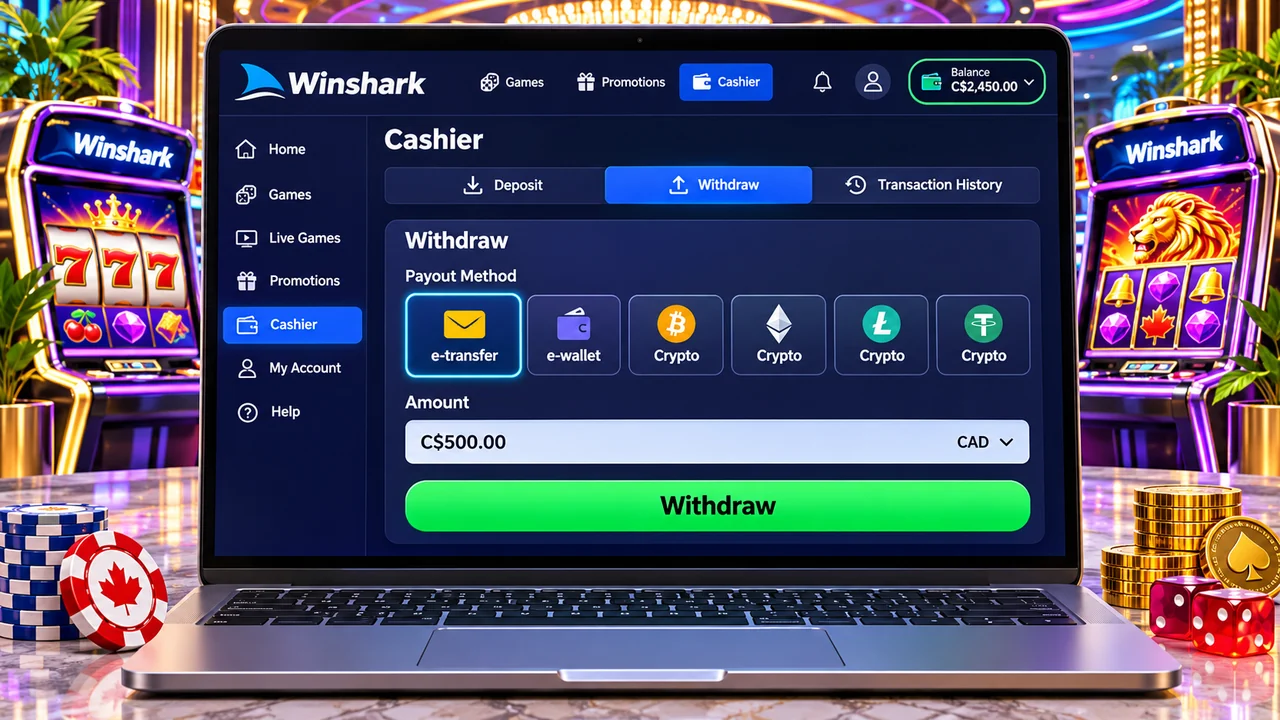
- Open the withdrawal tab in the cashier, not the deposit tab, and write down which methods are offered to your account, your province and Canadian dollars. The lists are not the same and the withdrawal list is the one that will matter.
- Note the minimum withdrawal, and the daily, weekly and monthly caps. A cap does not stop you being paid; it decides over how many weeks you get paid.
- Find the reversal or pending window in the terms and switch it off if the cashier allows it.
- Complete verification now. Identification, proof of address, proof of the payment method.
- Register Autodeposit at your bank for the exact email address or mobile number on the casino account.
- Fund with the method you want to be paid back to, from an account in your own name, in Canadian dollars.
- Decide about the bonus before you deposit, not after. If you want a clean cashout, decline it; mixed balances are the most common cause of a refused first withdrawal.
- Make a small test withdrawal early, while nothing is at stake emotionally, and keep the timestamps.
If you only do two of those, do verification and Autodeposit. Between them they remove most of the waiting that players attribute to the casino.
How to test an instant payout claim yourself
Claimed payout times are marketing until you have a timestamp. Testing one is straightforward and costs almost nothing.
Deposit a small amount, play a little so the balance is not an untouched deposit being returned, then request the smallest permitted withdrawal and record four times: when you submitted it, when the status changed to processing or approved, when the transfer notification arrived, and when your bank posted it. Those four stamps separate the operator's queue from the rail and tell you which number the site was advertising. Repeat once on a weekend and you will know whether its finance team works Saturdays — a question no FAQ answers honestly.
The mistakes that add days
- Cancelling a pending withdrawal and sending it back into play. It is the most expensive habit in online gambling and it also sends you to the back of the queue.
- Requesting a payout with unmet wagering attached, which can forfeit bonus funds rather than merely delay them.
- Withdrawing to a method the account has never deposited from.
- Uploading a cropped or compressed document, then waiting two days to be told so.
- Chasing the payment provider when the status still says pending. Until the operator releases it, there is nothing at the provider to chase.
- Opening a second account to speed things up. Duplicate accounts are grounds for closing both, and that is a far worse outcome than a slow payout. If the current account is the problem, read how the payout process works and raise it with support in writing.
Keep the record. A payout dispute is won with dates, amounts, reference numbers and the exact wording of the term being applied — the same evidence whether you are writing to the operator, to a provincial regulator or to a licensing body offshore.
Gambling is for adults: 19+ in most of the country, 18 in Alberta, Manitoba and Quebec. Set the amount before you open the cashier, because a bank debit can reach money meant for bills. In Ontario, ConnexOntario answers at 1-866-531-2600 at any hour; elsewhere, your provincial health service lists its gambling helpline.
Questions about instant withdrawals at Canadian online casinos
Is any casino withdrawal in Canada genuinely instant?
The transfer can be, on the right rail. The payout as a whole rarely is, because the operator's approval comes first and that is the stage with the most variables. The closest thing to instant is a verified account withdrawing cash — not bonus funds — by Interac e-Transfer to an address with Autodeposit registered.
Which payment method gives the fastest payout for Canadians?
Interac e-Transfer, as a domestic rail that runs seven days a week and does not wait for bank settlement windows. Push-to-card credits can be comparable when your issuer accepts them. Electronic funds transfers and cheques are the slowest, and e-wallets are fast only on the first leg.
Why does my withdrawal say pending when the site advertises instant payouts?
Because pending is the operator's own queue, before any money has moved. It covers the cancellation window, bonus checks, verification and risk review. The advertised speed describes the transfer that happens after this status clears.
Can I withdraw to a different method than the one I deposited with?
Sometimes, but it is the slow path. Operators return funds to the source where they can, under closed-loop anti-money-laundering practice. A new destination needs proof that it belongs to you, which adds a verification cycle to the payout.
Should I verify my identity before or after requesting a withdrawal?
Before, ideally on the day you register. Most cashiers accept documents immediately, and a verified account turns the first payout into a payment instead of an investigation. Leaving it until a withdrawal is pending guarantees the delay you were trying to avoid.
Does my province change how quickly I get paid?
Indirectly. The province decides which site you are on and therefore which cashier, which methods and which currency you get, and in Ontario and Alberta it also puts a named regulator and a published complaints route into the chain. The payment rails themselves are national.