
Winshark · Partner offerExplore WinsharkCheck terms and local eligibility. Legal gambling age applies.
 Casino HarbourCanada · independent guideWinshark offer
Winshark · Partner offerExplore WinsharkCheck terms and local eligibility. Legal gambling age applies.
Every withdrawal runs on three clocks, and a casino's marketing normally quotes only the fastest one. Knowing which clock a claim refers to is most of the work.
Clock one is the request. You press withdraw, the balance drops, and the cashier shows a pending entry. This part genuinely is instant everywhere. It also proves nothing, because no money has moved.
Clock two is approval. The operator decides whether to release the funds. At some casinos a rules engine clears small, routine requests from verified accounts with no human involved. At others every request waits for the payments team, who may work business hours only. This is the clock that separates a fast site from a slow one, and it is the one least often stated in plain numbers.
Clock three is settlement. Once approved, the payment travels over a rail the casino does not control: Interac, a wallet network, a blockchain, a card scheme or the banking system. Each has its own pace, and some stop for weekends and statutory holidays.
A site can truthfully advertise instant withdrawals when it means clock one, or clock three for a single method. What you care about is the sum. If the terms say requests are reviewed within a stated window and the method page says funds arrive shortly after approval, you have a real answer. If either half is missing, treat the claim as incomplete rather than false, and go looking for the missing half before you fund the account. Our same-day payout comparison walks through the full transfer for the brand this site covers.
Speed after approval is a property of the rail, not the casino. The table below ranks the methods Canadian players meet most often by how the rail itself behaves. It deliberately gives no minute counts for specific operators, because those depend on each site's own approval step.
| Method | Settlement after approval | Runs on weekends? | What usually holds it up |
|---|---|---|---|
| Interac e-Transfer | Typically minutes once sent | Yes | Bank security holds; no Autodeposit set up |
| E-wallets (e.g. MuchBetter, Skrill, Neteller) | Typically minutes to the wallet | Yes | Wallet not verified; second hop to your bank |
| Crypto (BTC, LTC, USDT and others) | Network-dependent; minutes to an hour or so | Yes | Confirmations required; wrong network chosen |
| Debit or credit card | Business days | No | Issuer processing; some cards cannot receive payouts |
| Bank transfer / EFT | Business days | No | Banking cut-off times and holidays |
| Cheque | Postal delivery plus clearing | No | Mail and your bank's hold policy |
Two patterns stand out. First, the fast rails are all ones where the casino pushes money to an identifier you control, such as an email address, a wallet account or a blockchain address, rather than asking a bank to pull or batch it. Second, the fast rails keep running on Saturday night and on Victoria Day; the slow ones do not. A request approved at 6 p.m. on the Friday before a long weekend can land in minutes by e-Transfer or sit until Tuesday by bank transfer.
One more rule shapes your options before speed even enters the picture: most casinos pay back to the method you deposited with, at least up to the amount deposited. If you fund the account with a prepaid voucher that cannot receive money, the cashier will route your withdrawal to something else, usually a bank transfer. Choosing the deposit method is therefore the first step in choosing the payout speed. The payout methods guide lists how this works at the brand reviewed here, and the cards page explains why card cash-outs are the slow lane.
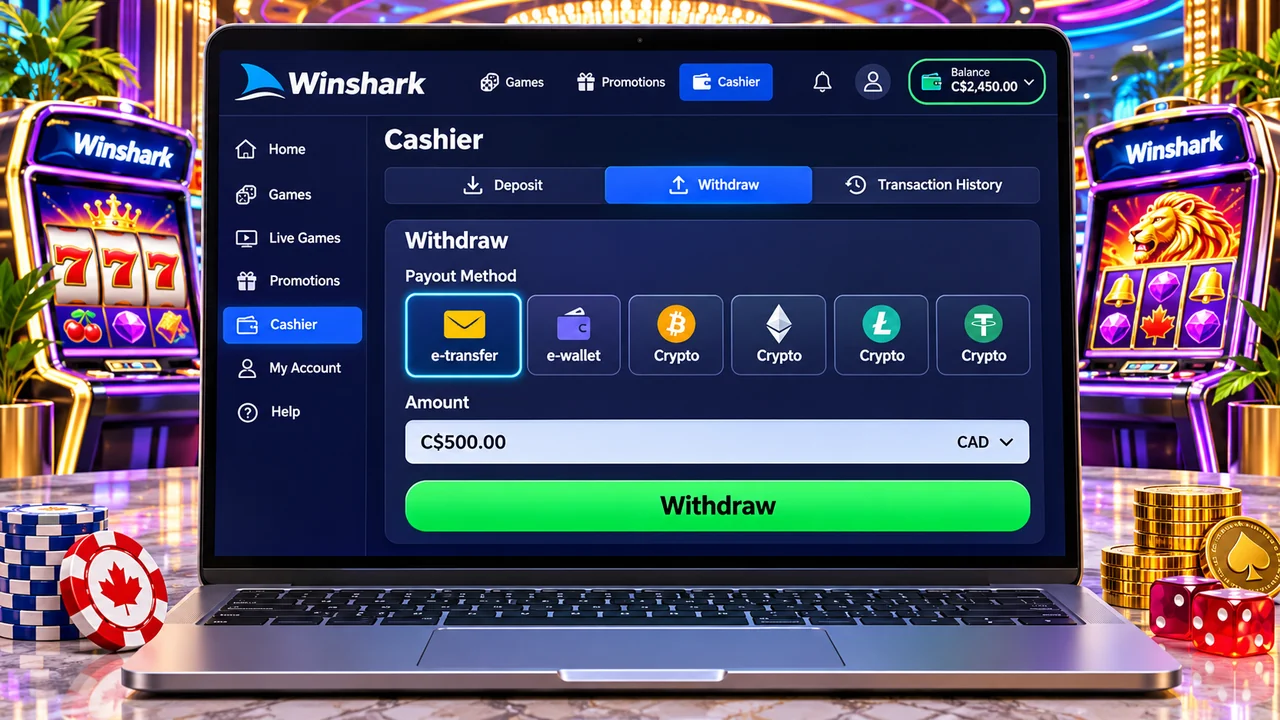
For most Canadians, e-Transfer is the realistic route to a payout that arrives while you are still at the screen. The casino, through a payment processor, sends a transfer to the email address or mobile number on your account, and your bank credits it.
Whether that last step is automatic depends on Autodeposit. With Autodeposit registered at your bank for that email address, the money drops straight into your chequing account with no action from you. Without it, you receive a notification and have to accept the transfer, sometimes by answering a security question the sender set. If the casino's processor sends a question-based transfer and you never saw the answer, the payout stalls on your side while the casino's records show it as paid.
Three checks make e-Transfer payouts predictable:
Banks also run their own fraud screening on incoming transfers and can hold one briefly. The casino has no way to speed that up, and support agents can only confirm the transfer left. For a method-by-method look at e-Transfer cash-outs, see the Interac withdrawal comparison.
The approval clock exists because a casino is obliged to know who it is paying and has a commercial interest in not paying out on broken bonus terms. Four checks account for nearly every delay.
A government photo ID, such as a driver's licence, passport or provincial photo card, plus a recent proof of address like a utility bill or bank statement. Many sites let you deposit and play before asking, then request documents at the first withdrawal. That is the single most common reason a first payout is not instant. Upload documents on day one and the first cash-out behaves like the fifth. The verification guide covers which uploads get rejected and why.
The casino wants evidence that the bank account, wallet or card belongs to the account holder. A deposit from the same method usually satisfies this. A brand-new withdrawal method with no deposit history often does not, and prompts a request for a screenshot or statement.
If a bonus is active, the system checks whether wagering is complete and whether any rule, such as a maximum bet or an excluded game, was broken along the way. A withdrawal requested mid-bonus is either blocked or forfeits the bonus. Neither outcome is fast. Before you request, open the bonus tab and confirm nothing is still running; the welcome bonus conditions page explains what to look for.
A withdrawal much larger than your deposits, a login from a new device or country, or several accounts sharing a household can each move a request from the automatic lane to a manual one. None of this implies wrongdoing. It does mean that large wins are, almost by definition, not instant payouts: bigger amounts get a human review and may be paid in instalments if the terms set a weekly or monthly ceiling.
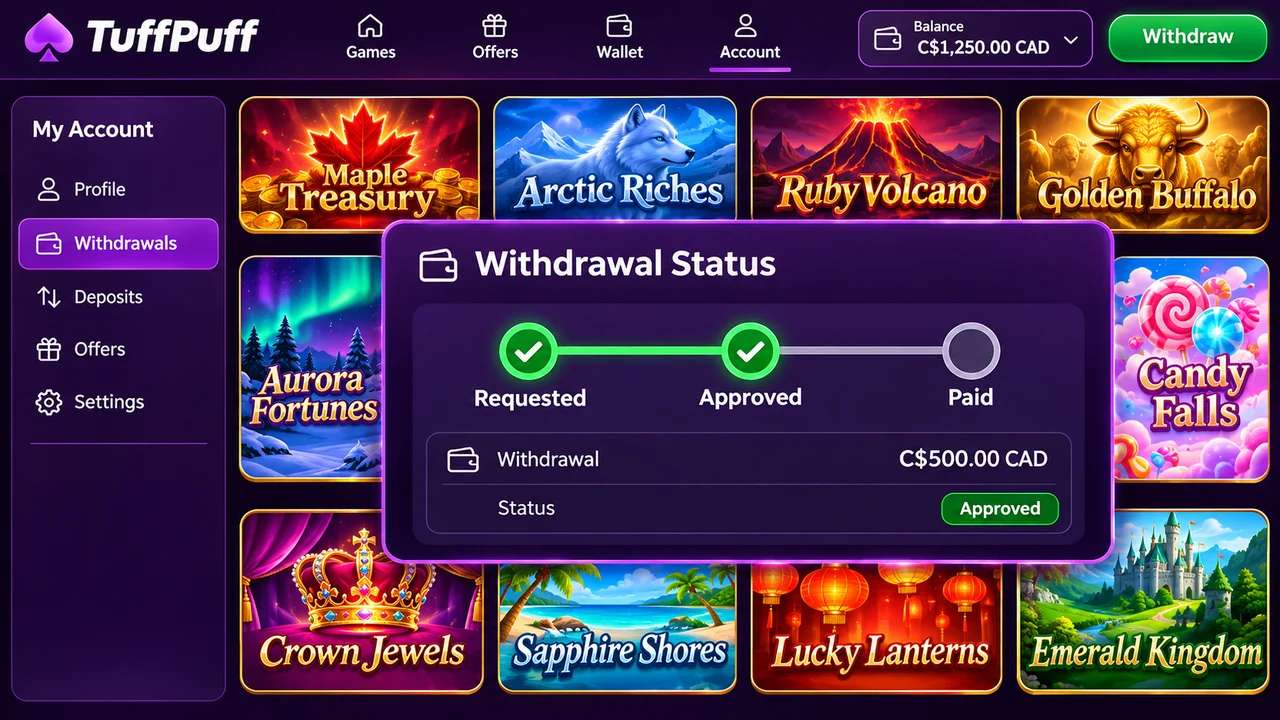
Where you live in Canada changes which casinos are open to you and who you can complain to if a payout drags.
Ontario has had an open, regulated market since April 2022. Private operators register with the Alcohol and Gaming Commission of Ontario (AGCO) and sign an operating agreement with iGaming Ontario. They run separate Ontario sites with their own cashiers, and an Ontario player dealing with a registered operator has a defined complaints path through the operator and then the regulator. Payment options on Ontario sites can differ from the same brand's site for the rest of Canada, so never assume a timing quoted for one applies to the other. Our Ontario checklist shows how to confirm an operator's registration yourself.
Other provinces run their own platforms through Crown corporations: PlayNow from the British Columbia Lottery Corporation, which also serves Manitoba and Saskatchewan; Espacejeux from Loto-Québec; PlayAlberta from Alberta Gaming, Liquor and Cannabis; and the Atlantic Lottery Corporation's site in the Atlantic provinces. These pay to Canadian bank accounts and publish their own withdrawal rules. They are not built around speed as a selling point, and their method lists are short.
Offshore operators licensed elsewhere, for example in Malta, Kahnawake or Curaçao, accept players from most provinces outside Ontario. This is where most instant-payout advertising comes from, and where crypto and e-wallet options are widest. The trade-off is recourse: a dispute goes to the operator and then to a licensing body outside your province. That makes the pre-deposit checks below more important, not less. For a province-by-province breakdown, see Canadian player casinos by province.
Ten minutes of reading tells you more than any ranking. Work through these steps in order and write down what you find.
Then run the only test that counts: a small real withdrawal. Deposit a modest amount by the method you intend to cash out with, decline the bonus, play briefly and withdraw. Note the time of the request, the time the status changes to approved or processed, and the time the money shows in your bank or wallet. You now have this casino's actual numbers for your account, your bank and your method, which no review can supply.
The following is an illustrative example with made-up times, not a measurement of any operator. It shows why the same site can be described as instant by one player and slow by another.
| Stage | Player A | Player B |
|---|---|---|
| Account state | Verified last month, no bonus active | New account, welcome bonus claimed |
| Method | Interac e-Transfer with Autodeposit | Visa debit |
| Request made | Saturday 8:10 p.m. | Saturday 8:10 p.m. |
| Approval | Automatic, same evening | Paused: ID requested, wagering check |
| Documents cleared | Not needed | Monday afternoon |
| Money received | Saturday evening | Later that week, after card processing |
Player A did nothing clever in the moment. The work was done weeks earlier: documents uploaded, a push-style method chosen, Autodeposit switched on, no bonus attached. Player B hit three separate brakes, and only one of them, the card rail, was outside their control.
This is also why averages published on comparison sites are of limited use. An average blends Player A and Player B into a figure neither of them experienced. Your own first test withdrawal is a better predictor than anyone's mean.
Crypto and wallets are the methods most often sold as instant, and on the rail itself that is often fair. The conditions are worth knowing.
A crypto withdrawal still passes the casino's approval step. After that, speed depends on the network and on how many confirmations the receiving side wants. Bitcoin produces a block roughly every ten minutes, so a transfer that needs several confirmations takes a multiple of that; Litecoin and several stablecoin networks confirm faster. The serious risk is not delay but error: sending USDT on one network to an address on another, or pasting the wrong address, can lose the funds with no one able to reverse it. Check the network name in the casino cashier against the one your wallet shows before confirming.
Remember the second leg. Coins in a wallet are not dollars in a bank account. Converting to CAD through an exchange and withdrawing to your bank adds its own steps, fees and, at Canadian-registered platforms, identity checks. If the goal is dollars in a chequing account, compare the whole journey against e-Transfer rather than the first leg alone. The crypto networks and fees page and the crypto casino comparison go into the details.
A wallet payout lands in the wallet quickly once approved. Moving it on to your bank is a separate withdrawal with the wallet provider's own timing and fee. Wallets also verify their users; an unverified wallet may accept the money and then restrict it. Set the wallet up and verify it before you rely on it for a payout, and make sure the wallet is registered with the same name and email as your casino account.
A fast payout that loses a slice to fees or conversion is not automatically the better one. Four costs deserve a look before you choose a method.
Minimums matter at the other end. If you play with small deposits, confirm the minimum withdrawal is within reach of a typical balance; the minimum deposit guide shows how deposit and withdrawal floors can differ for the same method.
And if a request has already been sitting longer than the stated window, stop submitting new ones, since duplicates can reset the queue. Gather the request time, method and any messages, then follow the steps in the pending withdrawal guide.
Gambling is for adults of legal age in your province, 19 in most and 18 in Alberta, Manitoba and Quebec. Set a budget before you play and treat any payout as a bonus, not a plan.
A withdrawal can arrive within minutes when the account is already verified, the request is approved automatically and the method is a push-style rail such as Interac e-Transfer, an e-wallet or crypto. The first withdrawal on a new account almost never is, because identity checks happen at that point.
On the rail alone, e-Transfer, e-wallets and faster crypto networks all settle in minutes. Which one is fastest for you depends on the casino's approval step and on what you need at the end: dollars in a Canadian bank account favour e-Transfer, since it has no second hop.
Pending means the casino has not approved it yet. The usual causes are outstanding verification, an active bonus, a request above the automatic-approval threshold, or a payments team that works business hours. Check your email and account messages for a document request before contacting support.
Not as a rule, but fees vary by method and operator. Read the withdrawal terms for per-transaction fees, charges on frequent withdrawals and currency conversion. A CAD account and a method that pays straight to your bank keep costs lowest.
They slow two things: manual approval, if the payments team is off, and bank-based rails such as card refunds and EFT. Interac e-Transfer, wallets and crypto keep settling around the clock once the casino has released the funds.
For recreational players, gambling winnings are generally not treated as taxable income in Canada. People who gamble as a business can be assessed differently, so anyone in doubt should ask an accountant or the Canada Revenue Agency.
18+ and the age required in your province. The +250% headline, 5.0 score and 2,748 review count were supplied by the site owner, not independently measured. Availability and eligibility are not confirmed for every Canadian account. Read the current operator offer, wagering, payment, game and withdrawal conditions before accepting. No payout time or winning outcome is guaranteed.
Checked 2026-10-26 · Canada Casino Harbour · Public-source editorial guide